
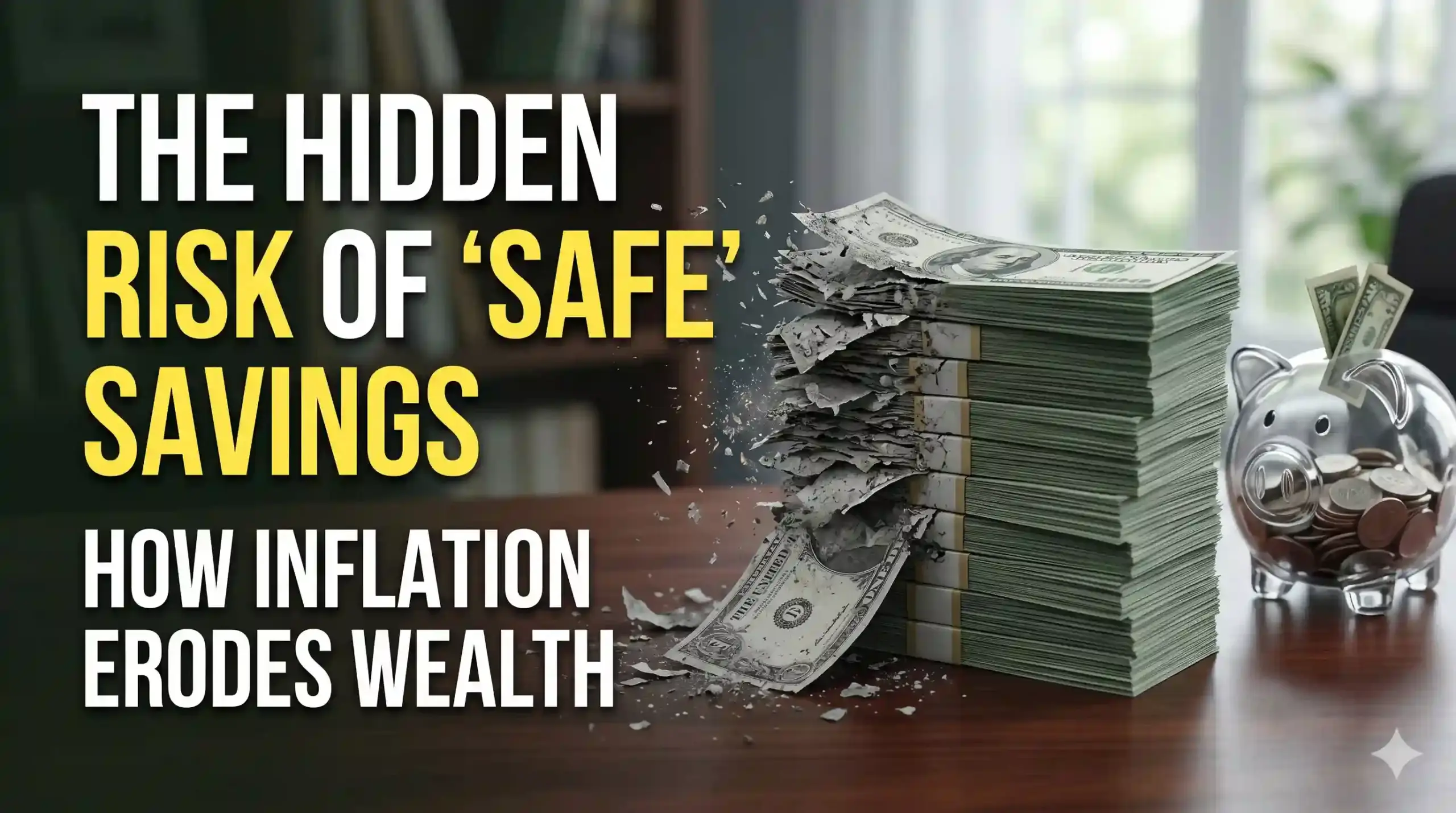
Think keeping your money in a savings account is safe? Discover how inflation quietly drains your purchasing power and why investing is the real key to long-term wealth.
The Hidden Risk of “Safe” Savings: How Inflation Erodes Wealth
Working with families over many years, I’ve noticed a pattern that cuts across income levels, nationalities, and backgrounds.
When people come into significant wealth—whether through a business exit, inheritance, a successful career, or years of diligent saving—their first instinct is almost always the same: protect it. They want to keep it somewhere safe and avoid risking what took so long to build.
It is a completely reasonable instinct. It just happens to be the wrong one.
What ‘Safe’ Actually Costs You
Here is the problem with playing it safe. Cash sitting in a bank account looks stable. The balance doesn’t fluctuate, and the number doesn’t move. But the purchasing power behind that number declines every single year.
Inflation is quiet and patient. It doesn’t announce itself with a market crash; it just works steadily in the background, continuously reducing what your money can actually do for you.
This is why we must define money, at its most useful, in terms of purchasing power. What can it fund? What kind of lifestyle does it make possible—not just today, but in 10, 20, or 30 years?
By that measure, a traditional savings account isn’t safe at all. It is losing ground, reliably, year after year.
Gold glitters, but it produces nothing. Bonds pay a fixed coupon that inflation steadily erodes. While these aren’t worthless financial instruments in every context, as long-term custodians of your purchasing power, they consistently fall behind. You are preserving the number while the actual value quietly drains away.
The Power of Assets That ‘Do’ Something
The alternative to cash is ownership. Specifically, ownership of productive businesses.
These are companies run by real people, solving real problems, and making things the world wants. When you hold equity in these businesses, you hold a claim on their earnings and on the growth of those earnings over time.
This matters because productive businesses adapt. They raise their prices when inflation rises. They find operational efficiencies. They enter new markets. The income they generate tends to grow, and because income drives value, the businesses themselves tend to grow in value, too.
Decades of financial evidence bear this out. Equities have outpaced inflation across every meaningful long-term period we can measure. That historical track record has survived wars, recessions, pandemics, political upheavals, and more than a few moments when highly intelligent people were absolutely certain the entire system was about to collapse.
The productive businesses of the world have a resilient way of continuing to produce.
Why We Still Reach for the Wrong Thing
If ownership of productive businesses is clearly the better long-term strategy, why do so many investors still gravitate toward cash and fixed-income assets?
Because the journey is uncomfortable.
A portfolio invested in equities will move. It will fall when markets get volatile—often sharply, and almost always at the worst-feeling moments. Our brains, hardwired over thousands of years to identify and avoid danger, read financial volatility as a physical threat. Conversely, the calm of a stable bank balance reads as safety.
But we are confusing the feeling of safety with the reality of it.
The account that doesn’t move is, by mathematical definition, being overtaken by inflation. The portfolio that fluctuates is the one with a genuine chance of maintaining and growing your purchasing power over time.
This is the fundamental trade-off that very few investors are ever clearly shown. Financial institutions often benefit from complexity, and the discomfort of staying invested during turbulent periods means many people panic and switch to “safety” at precisely the wrong moments.
The Decision That Actually Matters
The families who navigate wealth generation successfully aren’t necessarily the ones with the most advanced financial knowledge. They are the ones who clearly understand the real challenge in front of them.
The question isn’t, “How do I keep my money safe?”
The correct question is, “Where do I place my money to preserve and grow its purchasing power over the long term?”
Those are two very different questions, and they lead to vastly different outcomes.
Consider a retired couple with their wealth sitting entirely in cash and bonds. They may feel secure. But if inflation is running at 4% and their portfolio is only earning 2%, they are losing ground every single year. Do that for long enough, and the comfortable retirement they planned for starts to look drastically different.
The discomfort of staying invested in productive assets—through the volatility, through the media noise, and through the moments when it feels like everything is falling apart—is not a design flaw. It is the price of admission for real, long-term returns.
And it is a price well worth paying.
Disclaimer: The advice provided in this column does not constitute legal or financial advice and is provided for informational purposes only. Readers should seek appropriate, independent legal and financial advice from a regulated professional before making any investment decisions.